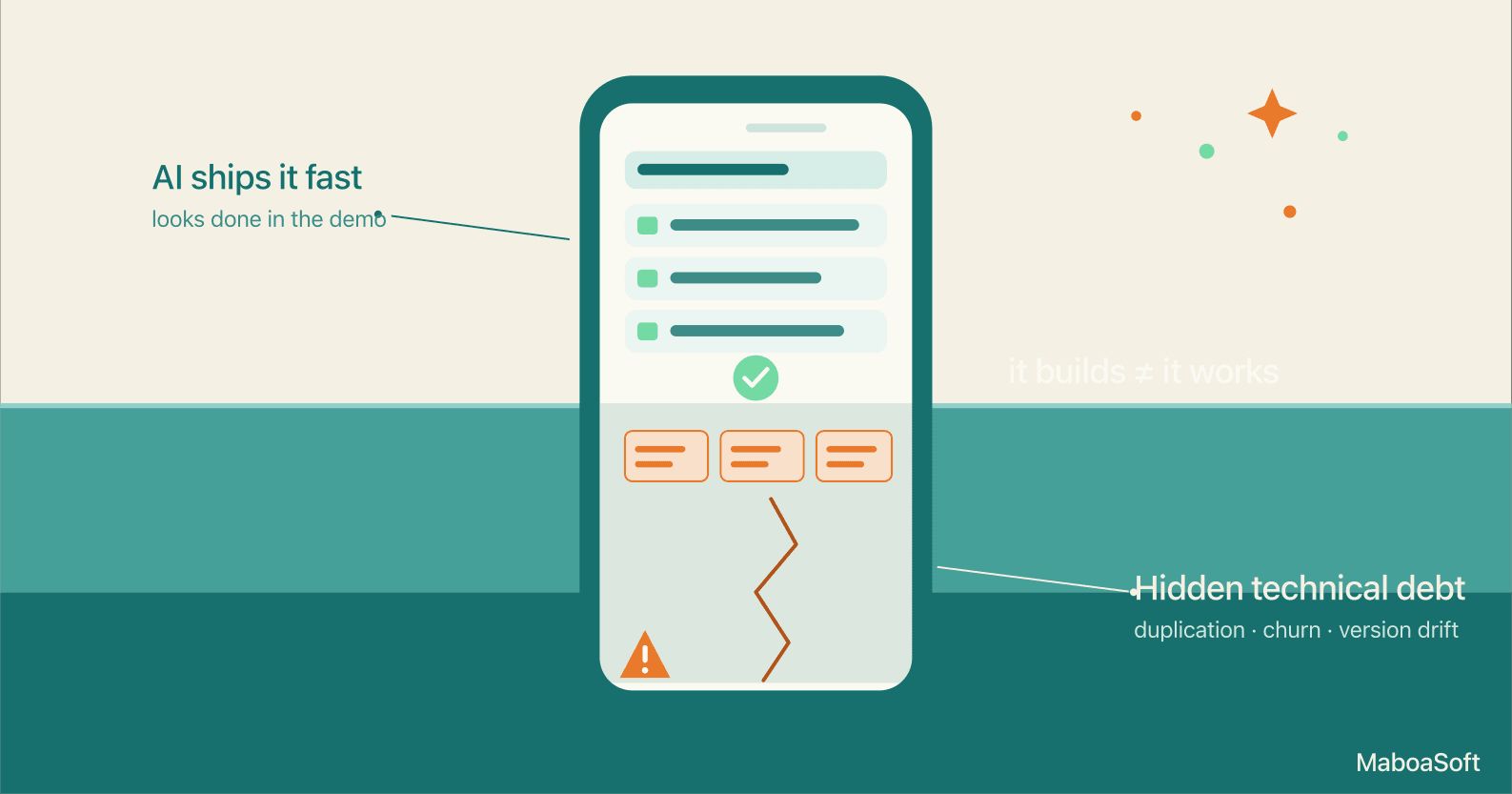
AI coding tools have made mobile development faster than at any point in its history. They have also introduced a new kind of technical debt that compounds faster, hides better, and resists the cleanup techniques teams have relied on for two decades. Here is how that debt forms in Flutter and .NET MAUI projects — and what to expect over the next 6 to 24 months.
There is a particular kind of silence that engineering leaders are starting to recognize. The app builds. The CI pipeline is green. The demo looks great. And yet, three sprints later, the team is patching more than it is building, a model update has quietly changed how a feature behaves, and nobody can fully explain why a screen that worked last month now stutters on a mid-range Android device.
That silence is technical debt — but a new variety of it. Generative AI did not remove technical debt from mobile development. It changed its shape. Teams that treat AI as a product system, with engineering discipline around it, ship faster and scale with far less risk. Teams that treat it as a shortcut accumulate a debt that stays invisible until users start complaining.
Two kinds of AI debt every mobile team now carries
When people say “AI technical debt,” they usually mean one of two different things. In mobile work, both appear at once, and they feed each other.
The first is debt in the code AI writes for you. This is the output of Claude Code, OpenAI Codex, GitHub Copilot and similar agents — the Dart, C#, Kotlin and Swift they generate on your behalf. The risk here is maintainability: duplicated logic, outdated APIs, shallow tests, and architecture that drifts because the assistant optimized for “make this compile now” rather than “keep this system coherent for two years.”
The second is debt in the AI features inside your app. More mobile products now embed LLM calls themselves — a chat assistant, a smart summary, an OCR-plus-reasoning flow, a voice command. That introduces prompt debt, retrieval debt, model-dependency debt and evaluation debt directly into your runtime, which is the framing enterprise analysts converged on through late 2025 and into 2026.
A senior mobile team has to manage both layers. The first decides whether your codebase stays shippable. The second decides whether your AI features stay trustworthy after the next model update. Most teams discover the second layer only when a provider version bump changes an output format and a screen breaks in production.
What the data is telling us
The shift is no longer anecdotal. By 2025, roughly 92% of US developers reported using AI assistants in their workflow, and AI problem-solving on the SWE-bench benchmark had climbed from around 4% in 2023 to nearly 70% in 2025. Capability and adoption both rose sharply — and so did the side effects.
GitClear’s 2025 AI Copilot Code Quality study analyzed about 211 million changed lines of code across repositories from Google, Microsoft, Meta and enterprise corporations over five years. The findings are sobering for anyone shipping mobile at scale:
- The frequency of duplicated code blocks rose roughly eightfold in 2024 versus prior years.
- 2024 was the first year on record where copy-pasted code exceeded “moved” code — meaning developers increasingly clone rather than refactor and reuse.
- Short-term churn — code revised or discarded within two weeks of being written — rose from about 3–5.5% in 2020 toward 8% in 2024, a signal of premature, low-confidence commits.
- Refactoring activity fell so far that analysts projected it could drop to a few percent of all code changes.
Why this matters for mobile specifically: duplicated code correlates with materially higher defect rates — research cited in these analyses puts the increase anywhere from 15% to 50%, and one 2023 study found more than half of co-changed cloned code was involved in bugs. On a mobile app, a defect does not sit on a server you can hotfix in minutes. It ships through an app store, lands on a fragmented set of devices and OS versions, and waits for a review cycle before you can correct it.
On the AI-features side, the first large-scale academic study of LLM-specific self-admitted technical debt (Aljohani and Do, presented at EASE 2025) analyzed more than 90,000 Python files and found that prompt design was the single largest source of LLM-specific debt, with instruction-style and few-shot prompts the most debt-prone techniques. Databricks and VentureBeat reached complementary conclusions for production systems — prompt stuffing, tool sprawl, opaque pipelines, retrieval drift and the absence of any real CI/CD for prompts. The common thread: the prompts your app sends to a model are untyped, untested code with no compiler to catch your mistakes, and they fail in front of users rather than in your IDE.
Why mobile makes AI debt worse
Most “AI code quality” commentary assumes a web backend you can redeploy at will. Mobile breaks that assumption in four ways, and each one raises the interest rate on AI debt.
Release latency. A bad backend deploy is reversible in minutes. A bad mobile release is gated by store review and by users who may never update. Churn that would be invisible on a web service becomes a frozen mistake in someone’s pocket.
Platform fragmentation. AI assistants are strong at “happy path” UI code and weak at the platform-specific edges that define mobile: background execution limits, permission models, notification channels, safe-area and edge-to-edge layout, battery and memory constraints. These are exactly the areas where generated code looks correct and fails on real hardware.
SDK and ecosystem velocity. Both Flutter and the .NET mobile stack move fast. Models are trained on a snapshot of the past, so they confidently emit code for last year’s APIs. This is, today, the single most common source of wasted time in AI-assisted mobile work.
On-device limits for AI features. Embedding an LLM feature in a mobile app means wrestling with latency, offline behavior, token cost on metered connections, and the privacy implications of sending user content off-device. The prompt-and-model debt that an enterprise web team can paper over with more compute is far less forgiving on a phone.
A story: the AI-built MVP that looked ready
To make this concrete, here is a composite scenario — illustrative, not any single project.
A B2B SaaS vendor needs a companion mobile app: login, a list view, item detail, photo upload, comments, push notifications, offline draft saving, and simple admin roles. The team uses an AI coding assistant heavily and builds the MVP in Flutter in a few weeks. The screens generate quickly, the backend integration works, photo upload works in the demo, push is partly configured, basic tests are generated, and the app runs on both simulators. Everyone is happy.
Then real users start testing it on real devices and real networks. Photo upload fails when the connection drops. Permissions behave differently on Android and iOS. Push notifications arrive twice for some users. Offline drafts overwrite newer online data. The app crashes on older devices. The CI pipeline works only on one developer’s machine. Tests pass but never covered the real edge cases. State management is inconsistent across screens.
The AI did not produce obviously “bad” code. It produced incomplete production logic. The MVP was fast; the debt arrived later. Now the team has to redesign the upload queue, separate UI from business logic, add real retry handling, rewrite the permissions flow, fix push, strengthen tests, stabilize CI/CD, audit security, and document the architecture.
This is the real shape of AI technical debt in mobile: the first 80% of the experience is fast, and the last 20% — where quality, trust and maintainability live — is where the cost hides.
Flutter and AI technical debt
Flutter is one of the most AI-friendly mobile frameworks. Its declarative UI, widget composition, strong docs and cross-platform model make it easy for assistants to generate screens, components, themes, forms, model classes and API clients. That same speed lets debt accumulate quickly.
1. Widget-tree debt. AI tends to generate large nested widget trees. The screen works, but the code is hard to read, test and reuse — and future UI changes slow down because nobody wants to touch it. Better: split generated UI into small named widgets and keep business logic out of the widget tree.
2. State-management drift. One screen uses setState, another Provider, a third Riverpod, a fourth BLoC because the model saw it in an example. The app compiles, but architectural consistency is gone, bugs get harder to trace, and the next AI suggestion becomes less predictable. Better: fix the state-management standard before AI starts generating features.
3. Dependency sprawl. AI adds a package for every small feature, which compounds into app-size, build-stability, compatibility, security and licensing problems. Better: require human approval before any new package.
4. Weak offline and sync logic. AI can generate simple caching, but production sync needs local queues, retry logic, conflict resolution, upload progress, background behavior and data-consistency rules. Better: design offline and sync architecture explicitly; do not let AI improvise it screen by screen.
5. Version drift — the most expensive default. Flutter practitioners documented through 2025–2026 that assistants routinely return code for an older SDK (for example, Flutter 3.24-era APIs) while the ecosystem has moved on — the official docs reflected releases in the 3.40+ range by mid-2026. Build configuration has also shifted, for instance toward the declarative Gradle Plugin DSL and away from older plugin-registration files. Generated code either fails to compile or uses deprecated patterns that compile today and break at the next upgrade.
The good news: Flutter debt is among the most mechanically detectable. Running dart analyze, dart fix and flutter fix inside CI, pinning SDK and package versions explicitly, and feeding the assistant version-aware rules with short examples of current idioms catches a large share of generated obsolescence before merge. Debt a linter can find is debt you can govern.
.NET MAUI and AI technical debt
.NET MAUI is a natural fit for teams already invested in C#, .NET APIs, Azure and Microsoft tooling. AI can generate XAML views, ViewModels, service interfaces, validation, dependency-injection setup, unit tests and migration helpers. The dominant risk here is architectural inconsistency.
1. Code-behind debt. AI puts logic directly in page code-behind because it is fast. Fine for a demo; in production, code-behind-heavy logic is hard to test and maintain. Better: keep business logic in ViewModels and services using MVVM.
2. MVVM inconsistency. A mature .NET mobile app relies on ViewModels, commands, observable properties, DI, services and navigation abstractions. AI follows these patterns in one file and ignores them in another, leaving the project half-structured and half-improvised. Better: give the assistant explicit MAUI/MVVM rules before generating features.
3. Platform-handler debt. MAUI sometimes needs platform-specific handlers or custom renderers. AI generates a quick Android or iOS workaround without isolating it, so one platform fix creates another platform bug. Better: keep platform-specific code clearly separated and documented.
4. Async and lifecycle bugs. Mobile is full of async behavior — API calls, loading states, navigation, cancellation, permissions, background/foreground transitions. Generated C# can miss cancellation tokens, UI-thread safety, or lifecycle edge cases. Better: review async code carefully and test on real devices.
Xamarin to .NET MAUI migration: AI can help, but it cannot decide your architecture
This is where the .NET mobile world is living through its most dramatic AI moment. In late 2025, Microsoft officially deprecated the rule-based .NET Upgrade Assistant and pointed teams to the GitHub Copilot app-modernization agent instead — a shift from a deterministic, step-by-step tool to an AI agent that assesses the codebase, writes a migration plan, and executes it as a sequence of tasks with incremental commits. Microsoft framed this within a broader push to attack the enterprise’s roughly $85-billion technical-debt problem, and Copilot has even become one of the top all-time contributors to the public dotnet/maui repository.
This is powerful for Xamarin to .NET MAUI migration — it compresses work that used to take months. But it introduces a failure mode that is uniquely dangerous in mobile: the silent runtime failure. A representative scenario reported across developer forums in 2025: a team migrates a Xamarin.Forms app with automated tooling, compilation succeeds, the IDE reports no errors, the app even deploys to a device — and then closes immediately on launch with no exception and no stack trace. Everything a compiler or an AI agent can check has passed. The failure lives in the runtime behavior of platform handlers, lifecycle events and dependency-injection wiring that the migration rewrote without fully understanding the app’s original intent.
There is a second, quieter trap: carrying old debt into MAUI. AI converts legacy code too literally, faithfully reproducing the architectural mistakes of a ten-year-old Xamarin app instead of taking the migration as the chance to decide what to preserve, what to rewrite, and what to remove. AI is excellent at analysis, explanation, renderer-to-handler conversion and migration checklists. It is not the right tool to decide whether a module should survive at all.
The lesson that runs through all of this: “it builds” is not “it works.” Migration agents optimize for a green build; users experience startup, permissions, native interop and the long tail of OS-specific behavior that a green build never tested. The fast-emerging ecosystem of MAUI “skills” for Copilot and Claude Code — curated, on-demand expert guidance for accessibility, safe areas, icons and Xamarin migration — is the right direction, and also a tell: raw model output needs a scaffold of mobile expertise around it to be safe. That scaffold is engineering judgment, and it does not come in the box.
Native iOS and the cross-stack reality
The same pattern holds for native iOS in Swift. AI is strong at view code, model types and boilerplate, and weak at app architecture, state management, permissions, persistence and lifecycle handling — the parts that decide whether an app is stable in the wild. Whatever the stack, a screen that looks correct in a simulator is not proof of quality. Real mobile quality is proven on real devices, with real users, under real network and lifecycle conditions.
CI/CD: the hidden place AI debt accumulates
AI debt is not only in application code; it hides in build and release pipelines too. Mobile CI/CD is complex — iOS signing and provisioning, Android keystores, versioning, secrets, test execution, build artifacts, TestFlight and Google Play deployment, crash-symbol upload, branch-based release flows. AI generates Azure DevOps YAML quickly, and the result is often fragile:
- Hardcoded build assumptions — the pipeline works once, because a specific agent, SDK version or environment variable happened to exist. Better: define SDK versions and environment setup explicitly.
- Poor secret handling — unsafe ways to manage signing keys, tokens or certificates. Better: use secure variable groups, key vaults, protected files and proper access control.
- No release traceability — a build exists, but the team cannot trace which commit, environment, configuration or version went to TestFlight or Google Play. Better: connect CI/CD to versioning, tags, release notes and artifacts.
- Missing quality gates — the pipeline builds the app but skips tests, static analysis, dependency checks and signing validation. Better: a pipeline should protect quality, not only produce builds.
Flutter vs .NET MAUI: where AI helps and where it hurts
The honest takeaway is not “one is better.” AI lowers the apparent cost of both, and the real cost surfaces in different places.
| Dimension | Flutter | .NET MAUI |
|---|---|---|
| Most common AI debt | SDK/version drift, widget-tree bloat, state-management sprawl, dependency sprawl | Code-behind debt, MVVM inconsistency, platform-handler bugs, silent post-migration crashes |
| Where AI shines | Greenfield UI, widgets, prototyping, API clients | Xamarin→MAUI assessment and planning, MVVM boilerplate, modernization |
| Where AI misleads | Confident use of outdated Dart/Flutter APIs | ”Compiles cleanly” migrations that fail only at runtime |
| Best guardrail | dart analyze / dart fix / flutter fix in CI, version pinning | Device-level smoke tests, startup/lifecycle suites, handler review |
| Net assessment | Debt is highly detectable and automatable | Debt is harder to detect; demands experienced manual review |
Flutter’s debt is mostly catchable by tooling. MAUI’s migration debt hides below the line that tooling and AI agents can see — which is why human, device-level verification matters more there.
The next 6 to 24 months
Reading the current trajectory, several developments look likely for mobile teams through 2027.
1. More AI-built MVPs will need rescue work. Founders and internal teams will keep using AI to ship prototypes fast. Many will look good and have weak foundations, and will need architecture review, dependency cleanup, state-management refactors, CI/CD stabilization, security audits and real-device QA to reach production. “Professionalizing AI-generated mobile codebases” becomes a category of work in its own right.
2. AI-native migration becomes the default for legacy mobile. With the rule-based Upgrade Assistant retired in favor of AI agents, expect Xamarin→MAUI and similar modernizations to be agent-led by default. The differentiator shifts from “can you migrate?” to “can you verify the migration on real devices?”
3. Evaluation and observability become first-class mobile disciplines. With no real CI/CD-for-prompts yet, expect benchmark prompt sets, multilingual checks, schema validation, latency thresholds, prompt registries and tracing to move from nice-to-have to table stakes for any app shipping an LLM feature — much as automated testing did a decade ago.
4. Refactoring returns as a budgeted line item. With duplication up and refactoring down, the correction is predictable: teams will pay specifically for codebase cleanup and AI-debt appraisal. Refactoring stops being assumed.
5. Regulation raises the floor. With the EU AI Act reaching fuller applicability in 2026, governance around AI features — data minimization, auditability, accountability — becomes a compliance issue, not just an engineering one. Apps that send user content to third-party models will need answers.
6. The senior-engineer premium rises, not falls. As raw generation gets cheaper and more abundant, the scarce skill becomes judgment: knowing which AI output to trust, where it silently fails on-device, and how to keep an AI-accelerated codebase coherent. “AI coding” becomes “AI-augmented delivery,” with AI used across requirements, architecture exploration, code and test generation, documentation, migration planning, QA scenarios, release notes and incident analysis — not just typing code. Teams that treat AI as an amplifier of senior engineering will pull ahead of teams that treat it as a replacement.
A responsible AI-augmented mobile workflow
AI debt is manageable once you stop treating AI-assisted development like ordinary development. A workflow that works in practice:
- Define the product context first — users, core workflows, platforms, offline and security requirements, integrations, release expectations, future scalability.
- Define the architecture before generation — for Flutter: state management, folder structure, API layer, dependency rules, testing strategy; for .NET MAUI / Xamarin migration: MVVM rules, service abstractions, DI, navigation, platform-code boundaries; for native iOS: architecture, state, permissions, persistence, lifecycle.
- Give the assistant explicit project rules — for example: use MVVM only; no new packages without approval; no business logic in UI files; reuse existing services; add tests for every ViewModel; never store secrets in code; always handle loading, empty, error and offline states.
- Generate small pieces, not whole systems — one screen, one ViewModel, one service, one test file, one migration helper at a time. Large uncontrolled generation creates review overload.
- Review, test and document — check every generated feature for architecture, security, platform behavior, performance, accessibility, test coverage and maintainability, then document why the solution exists. If AI helped build it, the team should still understand it.
A quick AI technical-debt checklist for mobile teams
Before accepting AI-generated mobile code, ask:
- Architecture: Does it follow the existing structure and chosen pattern (MVVM, Riverpod, BLoC, MvvmCross)? Is business logic separated from UI? Are platform-specific parts isolated?
- Mobile quality: Does it work on both iOS and Android? Was it tested on real devices? Does it handle permissions, offline and poor-network states, and background/foreground transitions?
- CI/CD: Are secrets handled securely? Are SDK versions defined? Are tests executed and artifacts traceable? Are store-release steps controlled?
- Security: Are tokens protected, local storage secure, logs safe, API permissions correct, and backend rules validated?
- Maintainability: Can another developer understand it? Does it duplicate existing logic or add unnecessary dependencies? Will it still be maintainable in 12 months?
How MaboaSoft helps
This is the work we do every day. MaboaSoft is a senior mobile engineering team that works across exactly the technologies where AI technical debt appears: Flutter, .NET MAUI, Xamarin modernization and migration, native iOS in Swift, C#/MVVM and MvvmCross architectures, Azure DevOps CI/CD, and backend integrations across Firebase, Supabase, REST and GraphQL. We use modern AI tooling heavily — and we wrap it in the engineering discipline that keeps the speed without the silent debt.
Where teams most often work with us:
- AI-generated code audit and mobile architecture review
- Flutter codebase cleanup and state-management consolidation
- Xamarin to .NET MAUI migration planning and execution, with real-device verification
- Native iOS review and C#/MVVM refactoring
- Azure DevOps CI/CD stabilization and release discipline
- Technical-debt assessment and the MVP-to-production transition — see our starter plans for rapid prototypes and a path to production
For more on how we use AI inside the engineering loop, including the Code-to-Spec (C2S) approach for legacy logic recovery, see our AI engineering page.
In short: we let AI write fast, and we make sure it still works on the ten-thousandth device, after the next OS update, and after the next model bump.
Conclusion: the future belongs to teams that can verify AI output
AI coding tools will keep improving — generating more code, understanding larger repositories, automating more tasks. But in mobile, the hard problems stay the same: architecture, security, offline behavior, platform differences, performance, app-store releases, CI/CD, testing and maintainability. AI can accelerate delivery. It cannot replace engineering responsibility.
The goal is not “let AI build the app.” It is to use AI to move faster while keeping senior engineering control over architecture, quality, security and delivery. That is the difference between an impressive prototype and a product that can grow.
Have an AI-built mobile prototype, a legacy Xamarin app, or a Flutter / .NET MAUI project that needs to become production-ready? Book a 20-minute call → We can audit the architecture, reduce technical debt, stabilize CI/CD, and turn fast AI-generated progress into a maintainable mobile product.
Frequently asked questions
What is AI technical debt in mobile development? It is the future maintenance cost created when AI-generated mobile code, architecture, tests or workflows are accepted without enough review, testing or documentation. In mobile it appears as two layers: debt in the AI-written code (duplication, outdated APIs, shallow tests) and debt in any AI features embedded in the app (prompt, retrieval and evaluation debt). Both are amplified by app-store release cycles and device fragmentation.
Does AI-generated code really increase technical debt? The evidence points that way. GitClear’s 2025 analysis of around 211 million changed lines found code duplication rose roughly eightfold in 2024 and that copy-paste exceeded code reuse for the first time, while refactoring declined. Duplicated code is associated with higher defect rates, which is especially costly on mobile where fixes ship through store review.
Can AI tools build Flutter apps? Yes. AI can generate Flutter screens, widgets, state-management code, tests and API clients. Production Flutter apps still need deliberate architecture, dependency control, version discipline and real-device validation to avoid widget-tree bloat, state-management drift and SDK version drift.
Can AI help with Xamarin to .NET MAUI migration? Yes, and it is now the default path — Microsoft retired the rule-based .NET Upgrade Assistant in favor of an AI-powered Copilot modernization agent. AI can analyze legacy code, draft a migration plan, convert views and renderers, and generate tests. Experienced engineers are still needed to decide what to migrate, rewrite, replace or remove — and to catch the silent runtime failures a clean build never reveals.
Is .NET MAUI good for AI-assisted development? It can be, especially for C# teams and enterprise mobile apps. The main requirement is to maintain clear MVVM architecture and avoid AI-generated code-behind debt, platform-handler shortcuts and async-lifecycle bugs.
How do we get the speed of AI coding without the maintenance cost? Pin SDK and package versions, gate AI output through linters and analyzers in CI, test what the build cannot see with device-level suites, treat prompts as versioned and evaluated code, budget for deliberate refactoring, and keep senior engineers reviewing architecture. AI then becomes a lasting advantage rather than a six-month sugar high.
Will AI replace mobile developers? No. AI reduces repetitive coding work, but the most valuable work shifts toward architecture, review, testing, security, migration and delivery quality — the judgment that decides whether a system stays coherent.
Written by the MaboaSoft engineering team. We build and modernize mobile apps in Flutter, .NET MAUI and native iOS for SaaS vendors and product companies.
Further reading (sources)
- GitClear — AI Copilot Code Quality 2025 (analysis of ~211M changed lines)
- Research page: https://www.gitclear.com/ai_assistant_code_quality_2025_research
- Full PDF: https://gitclear-public.s3.us-west-2.amazonaws.com/GitClear-AI-Copilot-Code-Quality-2025.pdf
- Aljohani & Do — PromptDebt: A Comprehensive Study of Technical Debt Across LLM Projects (EASE ‘25)
- arXiv (HTML): https://arxiv.org/html/2509.20497v1
- Official DOI (ACM): https://doi.org/10.1145/3756681.3756976
- Databricks — Hidden Technical Debt of GenAI Systems
- VentureBeat — Why prompt debt, retrieval debt, and evaluation debt are quietly reshaping enterprise AI risk
- Microsoft Learn — Upgrade a .NET app with GitHub Copilot app modernization
- Overview: https://learn.microsoft.com/en-us/dotnet/core/porting/github-copilot-app-modernization/overview
- Step-by-step guide: https://learn.microsoft.com/en-us/dotnet/core/porting/github-copilot-app-modernization/how-to-upgrade-with-github-copilot
- Upgrade Assistant deprecation page: https://learn.microsoft.com/en-us/dotnet/core/porting/upgrade-assistant-install
- Flutter documentation — AI best practices and breaking changes
- AI best practices: https://docs.flutter.dev/ai/best-practices
- Prompting: https://docs.flutter.dev/ai/best-practices/prompting
- Create with AI: https://docs.flutter.dev/ai/create-with-ai
- AI rules for Flutter and Dart: https://docs.flutter.dev/ai/ai-rules
- Breaking changes index: https://docs.flutter.dev/release/breaking-changes