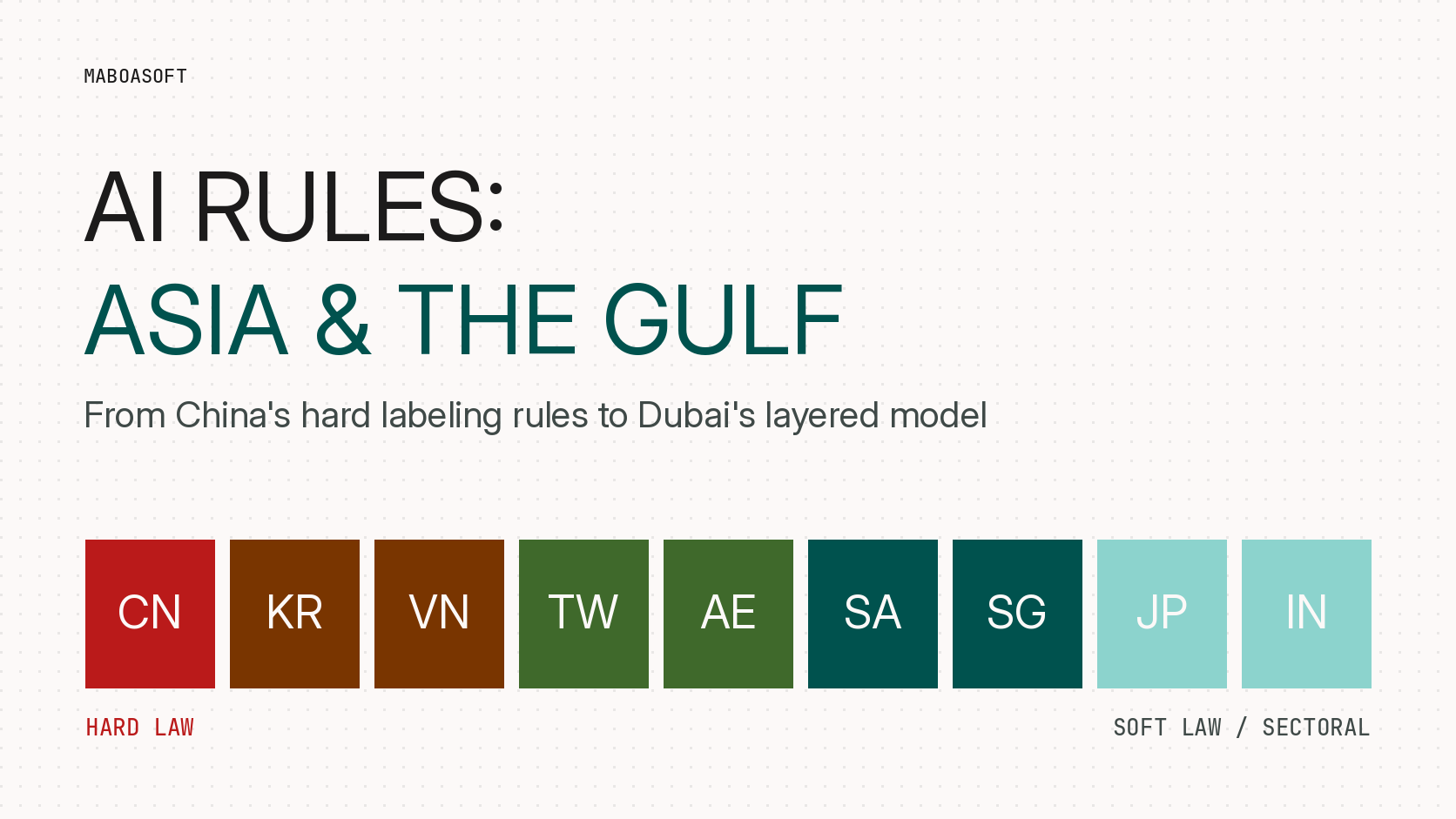
This is the third post in our series on AI regulation for app makers. We covered the EU AI Act — the strictest regime — and the US, UK, Canada, and Australia. Now the markets where the picture is most diverse: Asia-Pacific and the Gulf.
The spread here is enormous. On one end, China runs the world’s most operationally demanding AI compliance regime. On the other, Japan passed an AI law with no penalties at all. And the Gulf — often dismissed as a “no regulation” zone — binds companies through mechanisms that never appear in AI-law trackers: procurement, licensing, and data protection enforcement.
Legal state as of: July 2026. Several regimes described here took effect within the last six months. This is an engineering-team explainer, not legal advice.
China: the hard end of the spectrum
China regulates AI sector-by-sector with binding rules, and three of them matter to any app serving mainland users:
- Algorithm registration. Providers of algorithmic recommendation or generative AI services must register with the Cyberspace Administration of China (CAC) before offering them — a mechanism with no international equivalent.
- Generative AI Interim Measures (since August 2023): legality review of training data, content filtering, and clear labeling of AI-generated output.
- Labeling Measures (since 1 September 2025): synthetic content must carry both visible labels (watermarks) and invisible, machine-readable metadata — a closed loop making AI content traceable.
Amendments to the Cybersecurity Law effective January 2026 sharpen enforcement further. Where an app gets in trouble: offering any generative feature to mainland Chinese users without registration and dual labeling. Practical reality for small teams: China is a deliberate market-entry decision with local partners, not a checkbox — most SMB apps geo-scope it out until then.
South Korea: the world’s second comprehensive AI law
South Korea’s AI Basic Act took effect on 22 January 2026 — the first enforceable national framework after the EU’s. It follows a familiar shape: “high-impact AI” (systems significantly affecting life, safety, or fundamental rights) faces impact assessments, risk management, explainability, human oversight, and documentation; generative AI faces transparency and labeling duties. It applies extraterritorially to systems affecting Korean users, with a domestic-representative requirement above revenue and user thresholds. Penalty enforcement was postponed by one year — which makes 2026 the preparation window, not a free pass.
Where an app gets in trouble: a generative feature serving Korean users without disclosure and labeling, or a high-impact feature (credit, hiring, safety) without an impact assessment once penalties activate.
Japan: promotion over punishment
Japan’s AI Promotion Act (2025) is the opposite philosophy: a statutory basis for governance with no sanctions — only a “cooperation duty” to align with government policy, backed by a five-year, roughly ¥1 trillion public investment plan. The lifting is done by guidelines: government AI-appropriateness guidelines (December 2025), procurement check sheets evaluating AI suppliers, and sector expectations from the FSA (finance) and PMDA (medical devices).
The thing to watch: Japan’s privacy regulator proposed amending the APPI in January 2026 to introduce administrative fines for the first time, likely around 2027. Where an app gets in trouble: less through AI law, more through data protection and sector rules — and, for B2G work, failing procurement governance checks.
The rest of Asia in brief
- Singapore: sophisticated but voluntary — the Model AI Governance Framework, the AI Verify testing toolkit, and, since January 2026, the world’s first Agentic AI governance framework. Binding layer: the PDPA. Singapore compliance is a market-trust signal, not a legal mandate.
- Vietnam: a genuine hard law — the AI provisions of Law No. 134/2025 took effect 1 March 2026, with content labeling, transparency duties, and a local-presence or authorized-representative requirement for foreign providers of high-risk systems.
- Taiwan: enacted a basic AI framework law effective January 2026, risk-based and closer in spirit to Korea’s approach.
- India: no AI Act. Governance runs through the DPDP Act (phasing in through 2027), MeitY’s principles-based AI governance guidelines, and draft IT-rules amendments requiring visible labeling of synthetic media — soft law for the ecosystem, hard law where the harm is evident (deepfakes).
The Gulf: no AI Act, real teeth
The GCC is routinely misread as unregulated because no country has a horizontal AI statute. The binding mechanisms are just different:
- UAE runs a layered model. The federal PDPL is the data-protection backbone; the UAE AI Charter (2024) is formally non-binding but shapes procurement and vendor due diligence. The sharpest instrument is DIFC Regulation 10 — the first AI-specific regulation in the wider region, fully enforced since 1 January 2026 — imposing duties on autonomous and semi-autonomous systems processing personal data inside the DIFC free zone, including an Autonomous Systems Officer role for high-risk processing. The Central Bank issued binding-in-practice AI guidance for financial institutions in February 2026, and in June 2026 the UAE created a Federal Authority for Artificial Intelligence and Data, consolidating AI, data, and digital-government oversight — the clearest signal that the layered model is institutionalizing.
- Saudi Arabia centralizes through SDAIA and declared 2026 the Year of AI. The AI frameworks (ethics principles, generative AI guidelines, adoption framework) are formally non-binding — but SDAIA alignment is increasingly required for government contracts, and the enforcement muscle is real: dozens of PDPL enforcement decisions were issued in 2025, with fines up to SAR 5 million. A copyright-law exception for AI training data enters force on 1 August 2026.
- Qatar channels AI control through its central bank — the QCB AI guidelines are the only legally binding AI-specific sectoral instrument among the smaller GCC states. Kuwait announced an AI governance framework in February 2026; Bahrain has a proposed AI law and a strict biometric prior-authorization regime.
Where an app gets in trouble in the Gulf: not an “AI fine” — a data-protection fine, a lost government tender for missing an ethics self-assessment, or a licensing problem in a financial free zone. And a warning that cuts the other way: a Gulf-based app scoring, pricing, or screening for users in Europe is inside the EU AI Act’s extraterritorial reach without ever opening an EU entity.
One baseline, many adapters
Put all three posts of this series together and a clear engineering strategy emerges. The regimes differ in style — horizontal act (EU, Korea, Vietnam), state patchwork (US), regulator-led (UK, Japan, Gulf), state-directed (China) — but the underlying capabilities they demand overlap heavily:
- Disclose AI interactions — EU, Korea, Utah, UK expectations, GCC charters.
- Label generated content, with machine-readable marking — EU Article 50, China, Korea, Vietnam, California. One well-built labeling layer covers most of them (China’s specifics are the exception).
- Assess and document high-impact features — EU high-risk, Korea high-impact, DIFC high-risk processing, Colorado 2027.
- Keep a human in consequential decisions — near-universal.
Build these once, at the architecture level, and each new market becomes a thin adapter — a local representative here, a labeling format there — rather than a new compliance program. As we argued in the previous posts, the cheapest moment to do this is during a modernization: if a legacy app is being rebuilt in Flutter anyway, the disclosure UI, marking pipeline, and audit logging are design decisions, not retrofits — provided you have recovered what the system actually does before classifying it.
Start with the triage: our free self-assessment checker (EN/ES) classifies your AI feature against the EU baseline and generates a PDF obligations report. For a market-by-market walkthrough of your product, book a 20-minute call.
FAQ
Which Asian countries have binding AI laws in 2026?
China enforces multiple binding AI regulations, including generative AI measures, algorithm registration, and mandatory labeling of synthetic content since September 2025. South Korea’s AI Basic Act took effect on 22 January 2026 and applies extraterritorially to systems affecting Korean users. Vietnam’s AI law took effect on 1 March 2026 with labeling and local-representative requirements, and Taiwan enacted a basic AI framework law. Japan, Singapore, and India rely primarily on voluntary or sectoral frameworks.
Does the Gulf region have an AI Act?
No GCC country has a horizontal AI statute as of mid-2026. The binding layer is data protection law — the UAE’s PDPL, Saudi Arabia’s PDPL, and free-zone regimes like DIFC — plus sector rules such as central-bank AI guidance. The UAE’s DIFC Regulation 10, fully enforced since January 2026, is the region’s most AI-specific instrument, and the UAE created a Federal Authority for AI and Data in June 2026. Soft-law charters become binding in practice through government procurement.
Do Chinese AI rules apply to a foreign app?
If your app provides algorithmic recommendation or generative AI services to users in mainland China, yes — including CAC algorithm registration and both visible and machine-readable labeling of AI-generated content. China’s regime is structurally different from the EU’s and cannot simply be covered by an EU-baseline program; most small teams handle it by geo-scoping China out until they have local partners.
What is the single most efficient way to cover these markets?
Build to the EU AI Act plus a recognized risk framework as your baseline — disclosure of AI interactions, machine-readable marking of generated content, documentation, human oversight — then add thin country adapters: a domestic representative for Korea above thresholds, labeling format tweaks, local data-transfer compliance in the Gulf. One content-labeling capability built to EU Article 50 specifications largely satisfies South Korea, Vietnam, and California at the same time.
This article summarizes the regulatory position across Asia-Pacific and the GCC as of July 2026, based on official sources and major law-firm and policy analyses. Several regimes described here took effect in 2026 and continue to evolve. This is general information, not legal advice.